Advanced Cooling
Two-Phase Immersion Cooling: Unlocking the Potential of Phase-Change Heat Transfer
A technical examination of boiling-based server cooling, dielectric working fluids, condenser design, and the practical barriers to commercial deployment.
Introduction
The rapid growth of AI computing is increasing thermal loads within data centers. High-performance accelerators concentrate substantial heat into compact packages, placing greater demands on cooling infrastructure.
Two-phase immersion cooling offers a different approach to this challenge. Instead of relying primarily on forced air or liquid flowing through cold plates, compatible electronic assemblies are immersed in a dielectric fluid that absorbs heat and undergoes a phase change.
The concept is attractive because boiling can transfer significant heat through latent heat of vaporization. However, the practical value of this approach depends on more than its heat-transfer performance.
How two-phase immersion cooling works
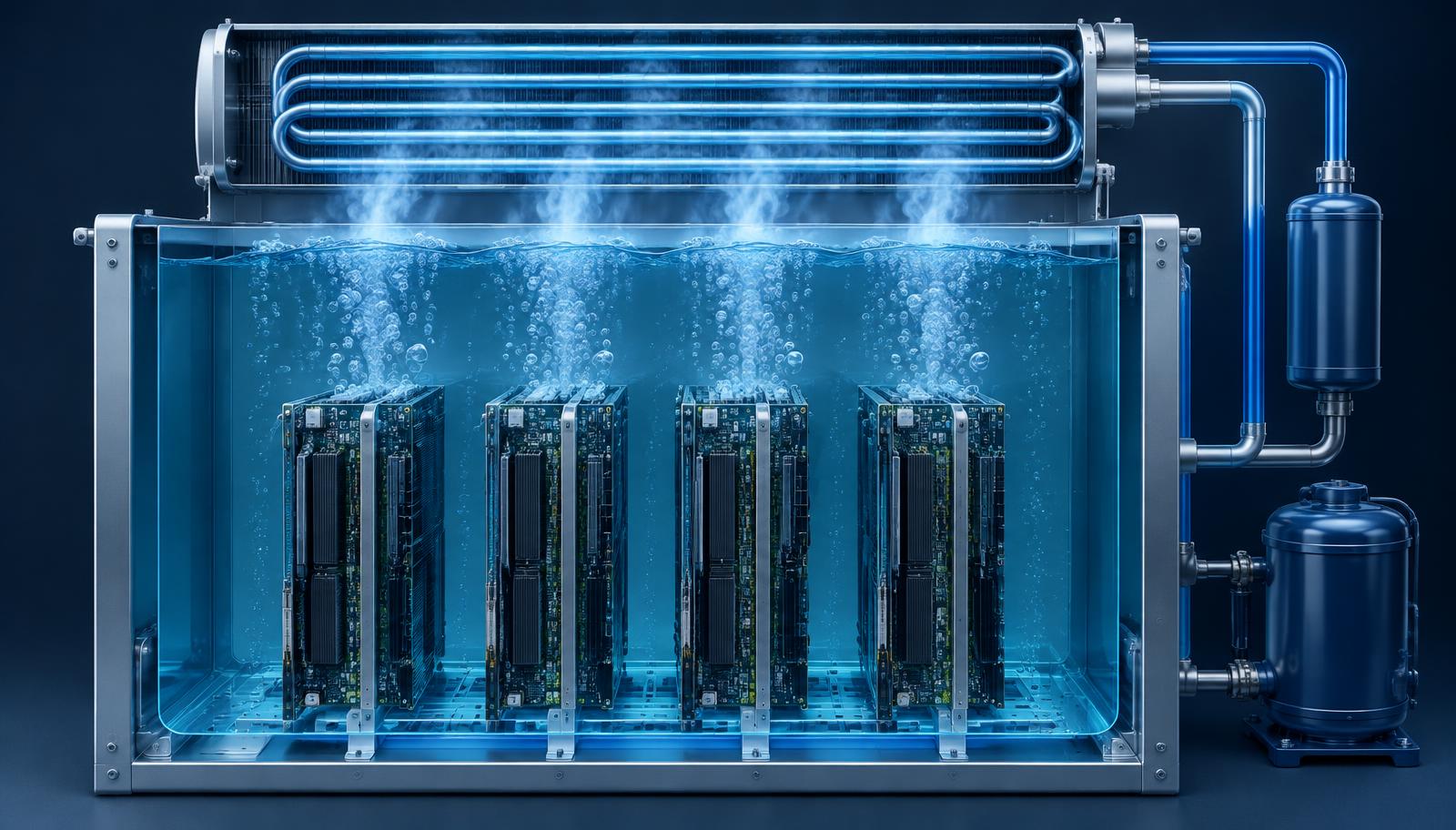
A two-phase immersion system places compatible servers or electronic assemblies in a tank containing a dielectric working fluid.
As components generate heat, the fluid boils and produces vapor. The vapor rises toward a condenser, where heat is transferred to a secondary cooling circuit. The vapor condenses and returns to the liquid reservoir, allowing the cycle to repeat.
The system therefore has three important thermal stages:
- Heat transfer from electronic components into the working fluid.
- Phase change and vapor transport within the immersion enclosure.
- Condensation and transfer of heat to the facility’s ultimate heat-rejection system.
- 01Electronic components
- 02Boiling dielectric fluid
- 03Vapor to condenser
- 04Secondary coolant circuit
- 05Facility heat rejection
The third stage is particularly important. Immersion cooling does not eliminate the need to reject heat from the facility. It changes how that heat is collected and transferred.
Potential advantages
Two-phase immersion can provide highly effective heat transfer under suitable operating conditions. The liquid directly contacts compatible electronic components, and the boiling process can transfer heat without requiring conventional forced circulation of the bath fluid.
Potential advantages include reduced dependence on server fans, uniform fluid contact around compatible components, and opportunities to simplify certain thermal-management arrangements.
However, system-level energy consumption still includes condenser cooling, pumps in secondary circuits where used, controls, and supporting infrastructure.
Why adoption is challenging
Several considerations affect commercial viability.
- Working-fluid availability: The fluid must satisfy thermal, electrical, environmental, safety, and materials-compatibility requirements. Supply-chain continuity and future regulatory requirements are important procurement considerations.
- Hardware compatibility: Circuit boards, connectors, polymers, seals, labels, storage devices, and other components must be qualified for prolonged exposure to the selected fluid.
- Maintenance: Hardware replacement, fluid handling, enclosure design, leak management, and service procedures differ from conventional server maintenance.
- Condenser performance: Efficient heat rejection depends on condenser sizing, coolant temperatures, operating conditions, and facility integration.
- Economics: The relevant comparison includes the complete installation, hardware qualification, working-fluid costs, energy consumption, maintenance, and lifecycle risks—not cooling efficiency alone.
Comparing alternative architectures
Two-phase immersion should be evaluated alongside direct-to-chip liquid cooling, single-phase immersion, and two-phase direct-to-chip approaches.
Direct-to-chip systems may be easier to integrate into existing data center operating models. Immersion can offer advantages in specific applications, but requires a different approach to equipment qualification and maintenance.
There is no universal winner. The appropriate architecture depends on rack power density, server design, operating temperatures, facility constraints, and the workload.
Conclusion
Two-phase immersion cooling is a technically compelling approach, but its commercial success depends on a complete and reliable system rather than phase-change physics alone.
Developers should evaluate heat transfer, working-fluid risks, hardware compatibility, condenser design, maintenance, and lifecycle economics before committing to deployment.
This article is general engineering commentary. Final designs require project-specific engineering and appropriate professional review.
Sources & further reading
- ASHRAE — Technical resources on data center thermal guidelines (TC 9.9)
- Open Compute Project — Cooling Environments project
This article explains general engineering principles and does not rely on proprietary data or measured project results. Formal citations for any externally derived figures are under editorial review before publication.
Evaluate Your Cooling Architecture
Considering immersion or another advanced cooling approach? We can review your rack densities, hardware constraints and facility interfaces to compare architectures on a whole-system basis.