Seawater & Thermal Engineering
Seawater Cooling: The Heat Sink Is Only Half the Problem
How to evaluate the thermal, hydraulic, material, and environmental factors that determine whether seawater cooling is viable for AI infrastructure.
Introduction
Seawater can provide a substantial heat sink for computing facilities located near suitable coastal environments.
The concept is straightforward: transfer heat from the facility into seawater rather than relying entirely on conventional air-side heat rejection.
But the ocean is not an unlimited, instantly available cooling system. Heat must be transported through an engineered hydraulic system, and the resulting discharge must satisfy site-specific environmental requirements.
The thermal balance
The heat carried by a water stream depends on its mass flow, specific heat capacity, and temperature increase.
A simplified heat balance is:
Q = ṁ × cₚ × ΔT
Heat transfer = mass flow rate × specific heat capacity × temperature difference
For an illustrative 30 MW thermal load, seawater density of 1,025 kg/m³, specific heat capacity of 4 kJ/kg·°C, and a 2°C temperature increase, the theoretical seawater flow is approximately 3.66 cubic meters per second.
ṁ = 30,000 kW ÷ (4 kJ/kg·°C × 2 °C) = 3,750 kg/s → 3,750 ÷ 1,025 ≈ 3.66 m³/s
Illustrative calculation only
This is a simplified calculation, not a final design specification. Actual systems must account for auxiliary heat, heat exchanger performance, temperature approach, hydraulic losses, redundancy, and operating constraints.
Why closed-loop heat exchange matters
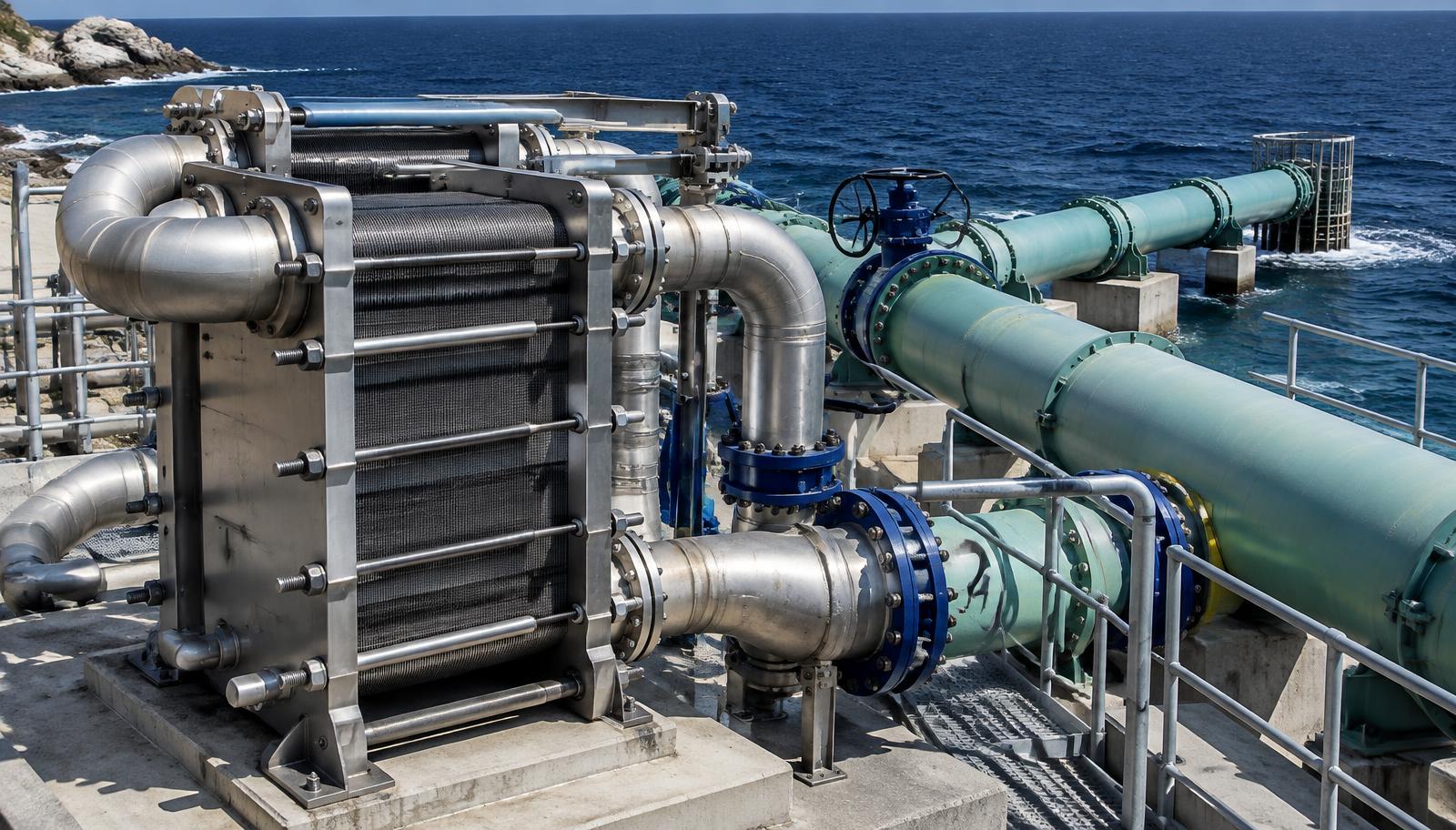
An isolated facility cooling loop can transfer heat to seawater through an appropriate heat exchanger without mixing the two fluids.
- 01Facility coolant loop
- 02Heat exchanger
- 03Seawater intake and screening
- 04Seawater pumps
- 05Engineered discharge
This allows the facility to maintain its specified coolant quality while the marine circuit handles seawater intake and discharge.
Materials selection is important because seawater can create corrosion and fouling challenges. Equipment selection should account for local water chemistry, biological growth, maintenance access, and expected operating conditions.
Environmental considerations
A thermal discharge can create a localized plume whose behavior depends on the flow rate, temperature difference, discharge geometry, currents, depth, and local ecology.
There is no universal discharge temperature that guarantees environmental acceptability in every location.
Site-specific assessments may need to evaluate temperature changes, marine-organism impacts, intake screening, water quality, and applicable environmental permits.
The economics of pumping
A seawater system can reduce dependence on conventional cooling equipment, but pumping requires energy.
The engineering objective is to balance heat exchanger performance, flow velocity, pressure losses, intake depth, discharge design, and maintenance requirements.
A system that transfers heat effectively but requires excessive pumping energy may not deliver the anticipated economic advantage.
Conclusion
Seawater cooling should be evaluated as a complete thermal and environmental system.
This article is general engineering commentary. Final designs require project-specific engineering and appropriate professional review.
Sources & further reading
This article explains general engineering principles and does not rely on proprietary data or measured project results. Formal citations for any externally derived figures are under editorial review before publication.
Request a Seawater Cooling Feasibility Assessment
Considering a coastal or offshore site? We can develop a preliminary heat balance, review intake and discharge concepts and identify the environmental questions to resolve early.